

For parents of teens with PDA: why I do parent coaching
I often hear from parents of teens who feel like they’ve missed the window for support.
Learning has become a daily battle.
Connection feels fragile.
And their child has started to believe they are the problem.
One parent came to me with a high-school student with a PDA profile who was experiencing ongoing work refusal and was unable to meet learning outcomes.
Despite paying for ongoing tutoring, nothing was shifting — not because this young person couldn’t learn, but because the way learning was being approached felt unsafe and overwhelming.
Mum felt disconnected and unsure how to help.
Her child was saying things like “I’m dumb” and “I can’t do this.”
After a small number of sessions, the biggest change didn’t come from more content — it came from changing how learning was offered at home.
When Mum adjusted her approach, everything shifted.
This teenager went from:
• refusing work
• avoiding challenges
• believing they weren’t good enough
to:
• proudly sharing learning with Mum
• feeling excited to try again
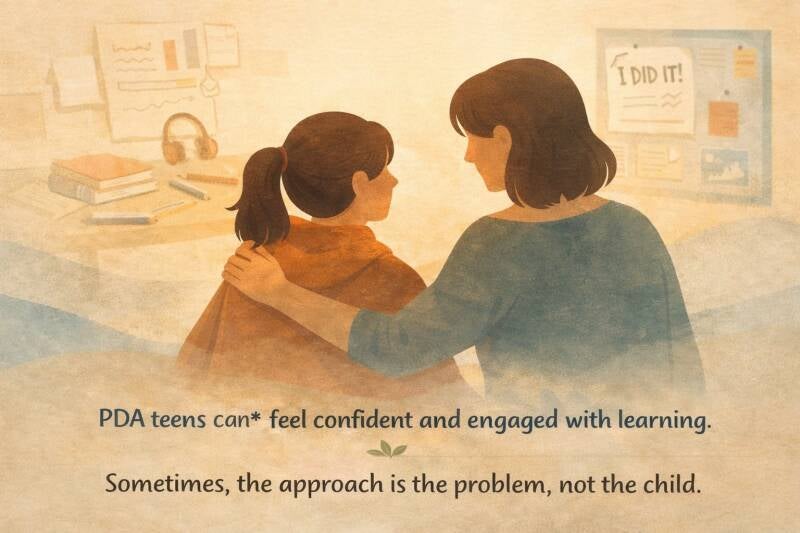
• saying, “I can do this — the way it was taught was the problem, not me.”
That mindset shift is why I do parent coaching.
Some of the supports we used were simple, but deeply intentional:
• Breaking learning into very small, clearly separated steps
(sometimes literally cutting worksheets apart or teaching one micro-skill at a time)
• Time-limited tasks (often 5–15 minutes), never everything at once
Writing, for example, was separated into:
spelling → sentence structure → vocabulary → purpose → planning → writing → editing
Each taught individually, on different days if needed.
• Meaningful, real-life learning
(e.g. persuasive writing based on something that actually mattered to the teen)
• Hands-on approaches for maths and abstract concepts
• A personalised regulation toolkit
created with the teen, not imposed on them
• Choice without pressure
“This task, that task, something different, or would you like me to choose?”
• Planned breaks before overwhelm hit
• Always finishing with reflection and a preferred activity
so learning ended with success, not depletion
This wasn’t about pushing harder or lowering expectations.
It was about removing threat, restoring agency, and rebuilding trust — for both the teen and the parent.
If you’re parenting a teen with a PDA profile and learning feels like it’s falling apart, it’s not too late — and nothing is “wrong” with your child
Sometimes, a small shift in approach changes everything.
I often hear from parents of teens who feel like they’ve missed the window for support.
Learning has become a daily battle.
Connection feels fragile.
And their child has started to believe they are the problem.
One parent came to me with a high-school student with a PDA profile who was experiencing ongoing work refusal and was unable to meet learning outcomes.
Despite paying for ongoing tutoring, nothing was shifting — not because this young person couldn’t learn, but because the way learning was being approached felt unsafe and overwhelming.
Mum felt disconnected and unsure how to help.
Her child was saying things like “I’m dumb” and “I can’t do this.”
After a small number of sessions, the biggest change didn’t come from more content — it came from changing how learning was offered at home.
When Mum adjusted her approach, everything shifted.
This teenager went from:
• refusing work
• avoiding challenges
• believing they weren’t good enough
to:
• proudly sharing learning with Mum
• feeling excited to try again
• saying, “I can do this — the way it was taught was the problem, not me.”
That mindset shift is why I do parent coaching.
Some of the supports we used were simple, but deeply intentional:
• Breaking learning into very small, clearly separated steps
(sometimes literally cutting worksheets apart or teaching one micro-skill at a time)
• Time-limited tasks (often 5–15 minutes), never everything at once
Writing, for example, was separated into:
spelling → sentence structure → vocabulary → purpose → planning → writing → editing
Each taught individually, on different days if needed.
• Meaningful, real-life learning
(e.g. persuasive writing based on something that actually mattered to the teen)
• Hands-on approaches for maths and abstract concepts
• A personalised regulation toolkit
created with the teen, not imposed on them
• Choice without pressure
“This task, that task, something different, or would you like me to choose?”
• Planned breaks before overwhelm hit
• Always finishing with reflection and a preferred activity
so learning ended with success, not depletion
This wasn’t about pushing harder or lowering expectations.
It was about removing threat, restoring agency, and rebuilding trust — for both the teen and the parent.
If you’re parenting a teen with a PDA profile and learning feels like it’s falling apart, it’s not too late — and nothing is “wrong” with your child
Sometimes, a small shift in approach changes everything.
Add comment
Comments